
Salesforce Will Start Metering AI Agent Calls. Agentic Identity Is Coming
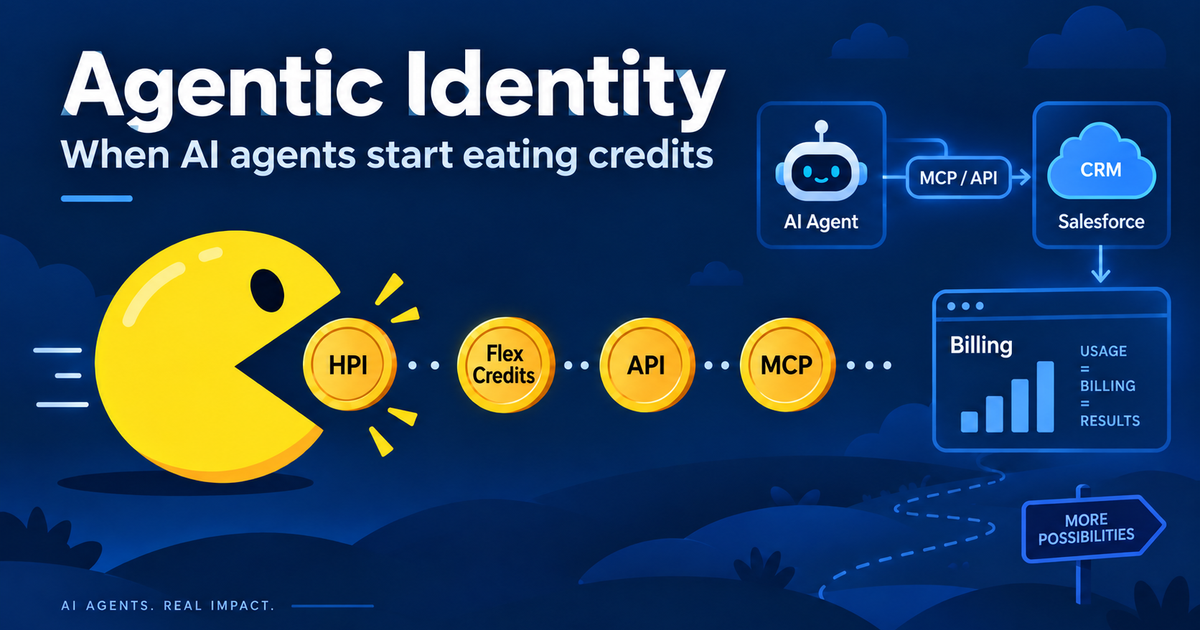
Salesforce is preparing a significant change for companies that connect external AI tools such as Claude, ChatGPT, or custom agents to Salesforce through MCP or API.
The new model is expected to arrive around November 2026 and will introduce two things: Agentic Identity and a new way of metering agent activity.
Agents will get their own identity
Today, an external agent often connects to Salesforce using a user’s credentials or a dedicated integration account. Salesforce wants to change that.
Administrators will be able to register an agent directly in Salesforce and assign it a separate Agentic Identity. The agent will get its own OAuth credentials, its own permission set, and access only to the data and operations explicitly granted to it.
A simple way to think about it: instead of letting an agent use an employee’s badge, Salesforce will give the agent its own badge.
Each agent interaction can be metered
Agentic Identity will also become the foundation for a new billing model. Each successful Salesforce call made by a registered agent - whether through MCP or directly through an API - will be recorded as a Headless Platform Interaction (HPI).
HPI usage will be visible in Digital Wallet and will consume Flex Credits. Salesforce has not yet announced the price of a single interaction. The current multiplier is marked as TBA, and Salesforce says customers will receive at least 30 days’ notice before billing begins.
What about MCP?
Salesforce says that using Salesforce MCP Server will require agent registration. Once Agentic Identity becomes available, customers will need to register the agent, assign permissions, generate new OAuth credentials, and reconfigure the MCP client.
From that point on, successful calls made by that agent may be counted as HPI.
What about regular API integrations?
Salesforce emphasizes that the change applies to agentic traffic - traffic generated by AI agents. Traditional API integrations are expected to keep the current licensing and security model.
Who will be affected?
According to Salesforce, new customers will have to register agents that use the API within three months of being notified that Agentic Identity is available. Existing customers are expected to move to the new model at renewal, while Salesforce MCP Server users will be required to register agents across all customers.
HPI is expected to be metered only in active production environments. Sandboxes, Scratch Orgs, and Developer Edition are not expected to consume Flex Credits for HPI, so development and testing should remain outside this billing model.
AIforce instead of Headless 360
Salesforce is evolving the concept previously communicated as Headless 360 under the AIforce name. The idea is straightforward: Salesforce should work not only through its own user interface, but also as a backend for AI agents operating in tools such as ChatGPT, Claude, Slack, or Microsoft Teams.
What does this mean in practice?
From a security perspective, the change makes sense: each agent gets its own identity, its own permissions, and separately monitored activity. At the same time, Salesforce is drawing a clear line between a traditional API integration and API or MCP traffic generated by an AI agent.
The most important piece is still missing: the price of one HPI. Only after Salesforce announces it will companies be able to calculate the real cost of connecting Claude, ChatGPT, or a custom agent to a production Salesforce org.
One thing is already clear: the era of “let’s connect AI to Salesforce through MCP and see what happens” is gradually ending. Salesforce wants to know which agent is performing an operation, what it is allowed to do - and how often it does it.
Source
Salesforce Help: Agentic Identity / Headless Platform Interaction: https://help.salesforce.com/s/articleView?id=005360285&type=1